
State of the Mod - March 2026 - Finding the Voice
Hi everyone! Mr. Cosmogone here with the latest Lordbound news!
As all of you hopefully know, the mod is already out and playable, but we are still hard at work to fix the legion of bugs that you have helped us hunt down. Before all, I want to take a moment to thank all of you who helped us test the mod despite its rough state. You have been of tremendous help in getting things ready for our definitive release later this year.

We are currently aiming for bigger patches rather than small updates that would require you to frequently reinstall the mod. As such, we’re planning to get our next update containing all the major voices ready by Q2 this year. As usual, I cannot yet give a more precise release window at this stage, but I am very excited to see you all get access to all the fixes and of course the voices of our amazing voice actors.
None of the voicework would be possible without two very special team members, and so today, I’d like to give them the mic for a peek behind the scenes at the process of audio editing:
The Voice Acting Pipeline
Hello! This is Moose and NeverNotNinja, Sound Lead and Casting Director respectively for Lordbound. We’ve been getting a lot of questions about our VA process on the Discord, so we thought it’d be of interest to walk you through our respective jobs step-by-step.
1. Casting
For unpaid internet-based projects, typically this would involve writing short descriptions and picking out a few challenging audition lines for our characters, posting them somewhere like the Voice Acting Club Discord or Casting Call Club, waiting a couple of weeks for audition submissions, and then whittling down the most suitable candidates. However, Lordbound found itself in a unique situation:

Because of this deadline, the first Lordbound casting call was posted in February of 2017. Way before he was on the team, NeverNotNinja applied as a VA through here. The team was small, and comprised of then-junior game devs who were understandably unfamiliar with the casting and recording process. This resulted in a slightly unorthodox casting system. Characters and lines were posted, but they were used as a method to see which Elder Scrolls races the auditionees were best suited to voice. Those voice actors were chosen (mainly by Arcky) then added to an internal roster with the intention of assigning them to characters and voice types (sets of characters who share the same voice) of their respective race(s) once their scripts were finalised.
Most scripts were not finalised until 2025, so most cast actors were left hanging without roles until now. We were of the opinion that making another casting call could have been seen as insulting to those who had waited patiently, so a little while after Kiria and Raz gave the go-ahead, we started re-establishing contact with dozens of VAs to see who was still available. Miraculously, most were! By the time we were done assigning them all suitable roles, we had already cast most of our characters. The remaining roles have since been filled via private auditions from a combination of applications through our website (organized by our miracle-working producer Yiannis) and recommendations by the fantastic Will Redwood, voice of Garom.
2. Dialogue Export
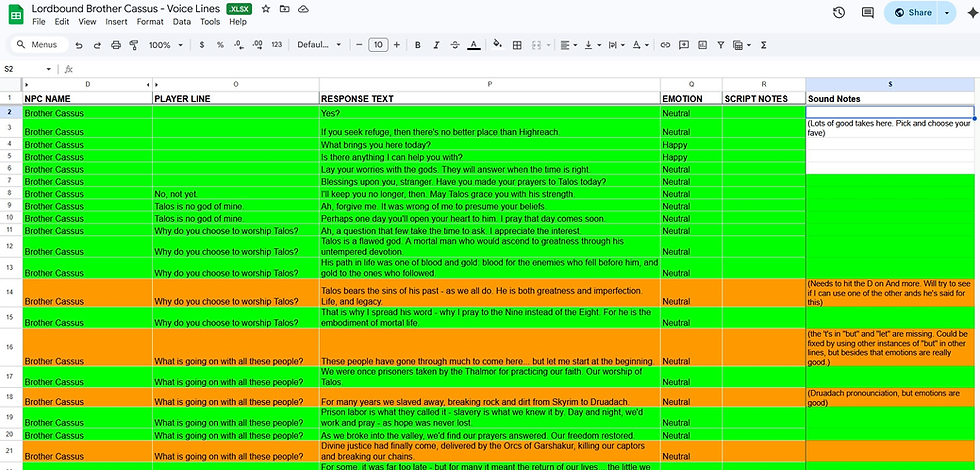
Once dialogue for a character or voice type is finalised, a specialised program must be used to extract the lines from the game. While developing the program, Raz consulted on how best to format the lines in script form for voice actors – we ended up with a concise spreadsheet format that could also be exported to PDF for ease of reading on phones and tablets:

Once the script’s ready, it’s sent to the VA along with a brief explanation of the character(s) and a link to our internal pronunciation guide. NeverNotNinja answers whatever questions he can, and sends them up the chain if he can’t. The VA is given a soft 30 day deadline to deliver their audio. He remains available in case they have any questions about the character or their lines.
3. Cutting

Once the actor delivers their raw audio files, they need to be cut up into individual lines. There are roughly 200 lines per voice type on average, with at least 3 takes each. Add in dead air and flubs, and it’s rare for the audio to clock in under 2 hours total. The line count is unavoidably inflated by the nature of Skyrim as an open-world sandbox: every character needs a line or two just in case the player decides to break into their house, set them on fire, steal their sweetroll, or so on. The image above is Garom’s session after it had been cut, and was clocked at 6 hours and 51 minutes long. However, most sessions are shorter than a main character in the story with over 400 lines.

The cutter chooses the best take for each line, exports it, and labels it with the correct sequence so that the editor can follow along. If there are no usable takes due to mispronunciation, incorrect delivery, technical issues or otherwise, they’re marked in the same spreadsheet to be sent to the editor to see if they can fix it or to send back with notes to assist retakes with the voice actor.
We are currently recruiting audio cutters to help the project reach completion. This position is open to anyone who has access to a basic digital audio work station like Audacity, Audition, or Reaper but no prior knowledge of sound editing is required. Some knowledge of what a good performance sounds like with any theater, voice acting background, or even film snob is preferred!
4. Editing

Once a performance has been cut by an audio cutter, it is assigned to an audio editor. An editor then goes through with a fine brush and polishes the performance to sound the best it can be to honor the voice actor and for your ear drums. They will remove a lot of sounds and breaths that when lowered or removed give a better feeling that the character is further away from the player which is pretty common in Skyrim’s dialogue and scene system. You can see this process in the image above with Garza’s recording session. The editor will also clean up clicks and harsh SSS sounds with EQ. They also process the audio when necessary with restoration tools like RX to remove background noise or unwanted echos from the recording room. They then export the performance with an auto normalizer to standardize the audio level in preparation for mastering and then send it to Moose. We are currently recruiting editors! If you have any experience in audio production and have access to a DAW like Protools or Reaper we need more people to help edit and add processing to performances for this project!
5. Mastering

Once the lines are edited, they need to be mastered to better fit into Skyrim’s soundscape and blend in with other actors’ performances. Like pretty much all other major modding projects, Lordbound is a fully remote production with contributors from all around the world. As a result, everyone is recording in a different place, using a different setup, and recording in their own time through a process the sound team has no way of monitoring.
While we try our best to provide our actors with recording instructions to help standardise the audio, inevitably there will be variance. Our editors do not have the luxury of high-end hardware or treated, monitored, or uniform recording spaces. Nonetheless, they make do. After a session is sent to Moose for mastering, he uses compression, a small amount of EQ, and monitoring to bring the volume of the performance to a certain desired average level of volume. He then compares the new recording to others to make sure they all sound decent when paired together.
The files are then sent off to Arcky to be correctly labeled for the Creation Kit and to troubleshoot any missing or repeated lines. Arcky developed a special software tool that looks at the character spreadsheet and the Skyrim data folder to apply the right file name to the right line. The system is designed to audit the pipeline process up until this point. After that, the files are converted into .FUZ files that are ready to be implemented.
6.Implementation and QA
Finally comes the moment of truth: the lines are sorted, treated, mastered… but do they sound right in-game? As they say, context is everything. Raz takes the final mastered recordings and adds them into Skyrim’s Data folder. He then pushes the files to our test branch, and internal playtesters are notified that they can check out an in-game performance before it is ready for a public release.
QA then reports to Raz, Kiria, Moose, and NeverNotNinja if there are any issues with a recording, allowing them to see if they can fix any problems with editing or mislabeled files, or if it needs to be sent back to an editor or voice actor. If there are no problems found, the performance is flagged to be included in the next patch of Lordbound for you all to experience!

That’s the process of giving our beloved characters their voices. If you’d like to help us tackle our backlog of recordings and bring the Druadach Valley to life, please fill out the application form on our Volunteer page!

